
Water Care
WATER CHEMISTRY – PLEASE READ CAREFULLY
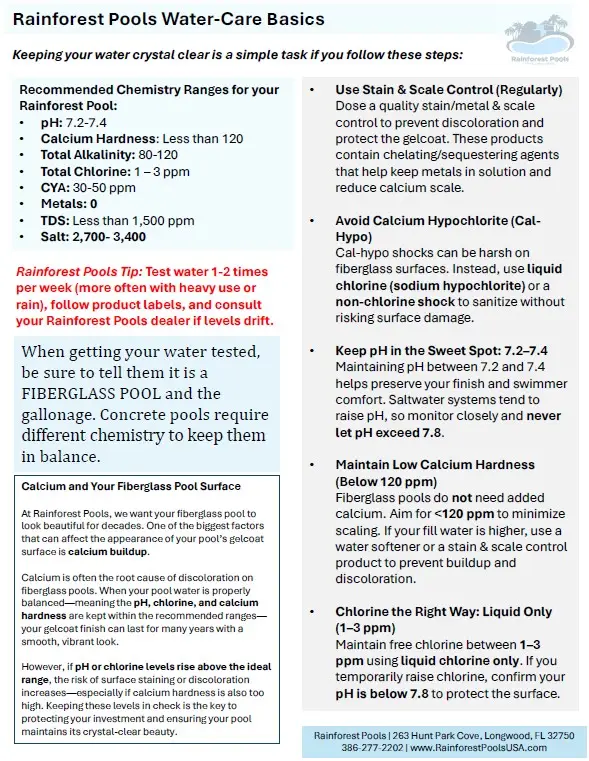
Water balance is critical to help protect the surface finish of your fiberglass pool. You must maintain balanced pool water and maintain the proper chemistry levels listed below.
WATER CHEMISTRY LEVELS
- CHLORINE RESIDUAL – 1.0 to 3.0 ppm
- pH LEVEL – 7.2 to 7.4
- TOTAL ALKALINITY – 80 to 120 ppm
- CALCIUM HARDNESS – Less than 120 ppm
- CYANURIC ACID / CHLORINE STABILIZER – 30 to 50 ppm
- METALS – 0 ppm
- TDS – Less than 1500 ppm
If using a salt system, the maximum should be 1000 ppm above the safe salt level. - SALT – 2700 to 3400 ppm
Only necessary if using a salt generator. - LANGELIER SATURATION INDEX – Ideal range is -0.3 to +0.3.
If you have a salt system, your saturation index range should be between -0.2 and +0.2 to account for the additional corrosive characteristics of salt.
CHLORINE RESIDUAL
Chlorine eliminates bacteria and algae by disinfecting and chemically destroying other materials, such as dirt and chloramines, through oxidizing as long as the correct pH is maintained. As chlorine is introduced into pool water, a portion is always consumed during the processes of disinfection and oxidation. That portion of available chlorine consumed is referred to as chlorine demand.
The hypochlorous acid left after the chlorine demand has been satisfied is the free chlorine residual. Free chlorine residual levels should be maintained between 1 and 3 parts per million and should never exceed 5 parts per million, as this can damage the pool surface.
If chlorine levels need to be raised above 3 ppm for breakout chlorination or super chlorination, it is essential to ensure your pH remains below 7.8 and calcium hardness stays under 120 ppm. Liquid chlorine is recommended for these treatments, as Calcium Hypochlorite, also known as Cal-Hypo, should be avoided.
Cal-Hypo can cause surface discoloration and damage, making it unsuitable for fiberglass pools. If your calcium hardness exceeds 120 ppm, it is crucial to regularly use a stain and scale control product to protect your pool’s surface.
Use a stain and scale control product regularly. This simple step helps protect the pool surface. These products contain chelating and sequestering agents that can effectively shield your pool from calcium.
pH LEVEL
pH is a measure of the acidity or basicity of water and directly affects some of the chemical reactions that occur in swimming pool water. It is measured numerically on a scale from 0 to 14, where 0 is very acidic, 7 is neutral, and 14 is very basic.
Pool water pH should be maintained between 7.2 and 7.4. A pH higher than 7.8 can cause damage to the pool finish as precipitation of mineral components, also known as scale, occurs. When pH is low, the acidity in the water can cause irritation to the eyes and mucous membranes of swimmers. Low pH, or acidic water, can also corrode metal parts of a pool system and damage the pool finish.
TOTAL ALKALINITY
Total alkalinity is a measurement of the amount of bicarbonate material in the pool water, and it indicates the water’s capacity to withstand changes in pH. It is very important to keep total alkalinity in range because low alkalinity can cause major swings in pH and damage the pool finish.
The recommended range is 80 to 120 parts per million.
CALCIUM HARDNESS
Depending on where you live, your source water may contain a certain level of calcium. Calcium levels should be less than 120 parts per million.
Fiberglass pool owners should not add calcium or products that use calcium to their pools, and those that live in a part of the country that contains calcium levels higher than 120 ppm should implement a stain and scale treatment as part of routine maintenance.
Too much calcium in the pool water can cause pH to rise. When the water’s pH rises above 7.4, calcification or scale can occur on the swimming pool surface. The calcium deposits onto the fiberglass pool wall, causing uneven discoloration and whitening of the pool surface.
CYANURIC ACID
Cyanuric acid prevents the sun’s ultraviolet rays from decomposing free chlorine in the pool water. As a chlorine stabilizer, cyanuric acid levels should be 30 to 50 parts per million.
If levels rise above 100 parts per million, chlorine is not as effective at killing bacteria and algae. In other words, more is not better. Often, pools reach excessive levels of cyanuric acid because many powdered chlorines contain cyanuric acid.
WATER BALANCE | SATURATION INDEX
Balanced pool water is neutral, meaning it is neither corrosive nor scale forming. To ensure your pool water is balanced, your Langelier Saturation Index must be within the specified range, with the target being 0.
Pool water is naturally trying to reach equilibrium. Equilibrium is not balanced. If your pool water is aggressive or corrosive, it will try to pull minerals out of the pool components, including the pool surface and its equipment. If it is scale forming, it will try to get rid of minerals by depositing them onto your pool surface and its equipment.
Therefore, pool owners must be vigilant by calculating their pool water’s Langelier Saturation Index and ensuring it is maintained within the specified range, with the target being 0.
Many pool owners fail by only concerning themselves with maintaining pH and chlorine; that is only a small part of the picture. Total alkalinity, calcium hardness, cyanuric acid, and TDS all play an important part in caring for your pool.
Pool surface color can discolor, fade, stain, yellow, or scale as the result of improper water chemistry and unbalanced water. Water chemistry is extremely important to all aspects of your pool and equipment.
Salt generators drive up pH and routinely require pH adjustment. pH should never go above 7.8. Salt generators can easily produce damaging amounts of chlorine and high pH levels, which can permanently damage the pool surface, causing fading and discoloration. Please monitor levels and adjust daily.
NOTICE
Remember, having crystal clear water does not necessarily mean that you have balanced water. You should check your water levels regularly. Be sure to test and record your water chemistry levels at least once a week and adjust accordingly.
Consult a knowledgeable pool professional for help and see our resources for more tools that can help you better understand proper pool care.
DO NOT USE CALCIUM HYPOCHLORITE.
YOU ARE RESPONSIBLE FOR THE CARE OF YOUR POOL.
Please invest the time and energy into educating yourself on water chemistry and proper pool care.